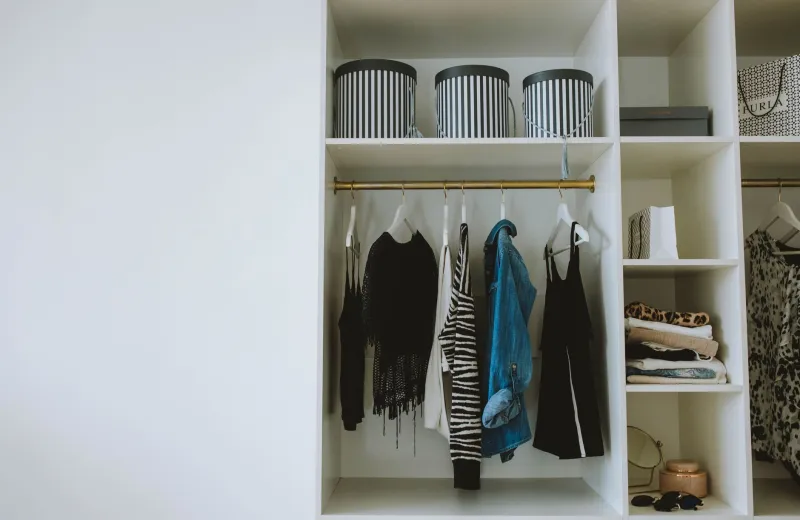
The Capsule Code: What Science Actually Says About How Much Clothing You Need

Most of us have stood in front of a stuffed closet and thought, I have nothing to wear. It's not a personal failure. It's actually a well-documented psychological phenomenon — and the solution, according to researchers and sustainable style experts, isn't more clothes. It's fewer, better ones.
At Wear AI, we're obsessed with the idea that one wardrobe can do infinite work. So we went deep on the numbers. What does the research actually say about how many pieces you need? And how do you build a formula that fits your actual life?
Why More Clothes Creates More Stress
Here's something counterintuitive: a closet with 150 items is harder to dress from than one with 30. Columbia University behavioral researcher Sheena Iyengar's famous "paradox of choice" studies showed that more options consistently lead to worse decisions and lower satisfaction. Fashion psychologist Dr. Dawnn Karen, author of Dress Your Best Life, has applied this directly to wardrobe behavior — she argues that decision fatigue starts setting in when we have too many variables to process before 9 a.m.
The average American woman owns 103 garments but wears only about 10% of them regularly, according to a 2022 survey by ClosetMaid. Men aren't much different. That's a lot of cognitive clutter hanging on a rod.
Minimalist wardrobe advocates — and increasingly, sustainable fashion brands — argue that the sweet spot isn't a number pulled from thin air. It's a formula built on three distinct clothing categories, each doing specific work.
The Three-Layer Framework
Fashion stylists and capsule wardrobe experts consistently organize a functional minimal closet into three tiers:
1. Foundation Pieces (The Non-Negotiables) These are your workhorses. Neutral-toned, high-quality basics that pair with virtually everything. Think: a well-fitted white tee, dark straight-leg jeans, a black crewneck, a versatile blazer, a clean white button-down. Most experts recommend 7–10 foundation pieces for a functional capsule.
2. Layering and Transitional Items This tier bridges your basics and adds adaptability across seasons and occasions. A lightweight trench coat, a chunky knit cardigan, a midi slip dress that works under or over other pieces. These are your multipliers. 5–8 pieces is the research-backed range here — enough to dramatically expand combinations without adding chaos.
3. Statement and Accent Pieces This is where personality lives. A bold printed scarf, a standout jacket, an unexpected shoe. These pieces don't need to be versatile — they need to be you. Experts suggest keeping this tier small: 3–5 pieces maximum, rotated seasonally.
Total? Somewhere between 15 and 23 pieces for a fully functional, season-adaptable wardrobe. That number might feel shockingly low. But let's do the math.
The Combination Equation
With 10 foundation pieces, 6 layering items, and 4 statement pieces, you're working with 20 total garments. Using a basic outfit combination formula (tops × bottoms × layers × accents), even conservative pairing rules generate well over 200 distinct outfits. Add in shoes and bags — which most capsule frameworks treat separately — and you're looking at 400+.
Here's a simplified version of the formula you can use yourself:
Outfit Combinations = (Tops × Bottoms) × Layering Options × Statement Modifiers
Let's say you have:
- 5 tops
- 4 bottoms
- 5 layering pieces
- 3 statement accents
That's 5 × 4 = 20 base outfits. Multiply by 5 layering variations = 100. Add statement modifiers = 300 combinations. From 17 pieces.
This is exactly the philosophy baked into Wear AI's approach — the idea that one wardrobe, built intentionally, can deliver infinite possibility without the overwhelm.
What the Experts Say About Personalization
Sustainable style consultant and founder of The Curated Closet method, Anuschka Rees, is quick to point out that the "right" number is never universal. "The formula has to account for lifestyle," she told us. "A teacher in Chicago needs different layering logic than a freelancer in Austin."
Fashion psychologist Dr. Karen agrees. "Your wardrobe should reflect your identity architecture — who you are, who you're becoming, and the contexts you move through daily. Numbers are a starting point, not a rulebook."
That's why we think about the capsule framework less as a strict count and more as a proportion model. The ratio of foundations to layers to statements matters more than hitting an exact number.
Build Your Own Formula: A Quick-Start Guide
Ready to run your own numbers? Here's how to start:
Step 1: Audit your actual life contexts. How many distinct "modes" do you operate in weekly? (Work, casual, active, social, formal?) Most people have 3–4 real contexts.
Step 2: Assign a core outfit to each context. What's the one outfit that makes you feel most like yourself in each setting? That's your anchor piece for that tier.
Step 3: Identify your true multipliers. Which items in your current closet show up in multiple contexts? Those are your capsule heroes — keep them, build around them.
Step 4: Apply the 3-tier ratio. Aim for roughly 45% foundations, 30% layers, 25% statements. Adjust based on your lifestyle.
Step 5: Run the combination math. Use the formula above. If your combinations drop below 100, you might need one or two more versatile pieces. If they're over 500, you probably have redundancy you don't need.
The Real ROI of a Smaller Wardrobe
Beyond the psychology, there's a financial case. The average American spends around $1,800 per year on clothing, per the Bureau of Labor Statistics. Capsule wardrobe adopters who've tracked their spending consistently report cutting that figure by 40–60% within the first year — not because they're depriving themselves, but because they're buying intentionally and buying less often.
And when you invest those dollars in higher-quality, more versatile pieces — the kind designed to work across seasons, occasions, and years — the cost-per-wear math becomes almost embarrassing in its efficiency.
Minimalism isn't about austerity. It's about precision. And once you see your wardrobe as a system with a formula behind it, getting dressed in the morning stops feeling like a problem to solve. It starts feeling like the easiest part of your day.